Restaurant Prime Cost Explained: The One Number SEA Owners Must Track Every Week in 2026
Prime cost — food plus labour — is the single number that decides whether your restaurant survives 2026. Here is exactly what it is, the healthy ranges by concept, and how to track it weekly across Singapore, Malaysia, Thailand and Indonesia.
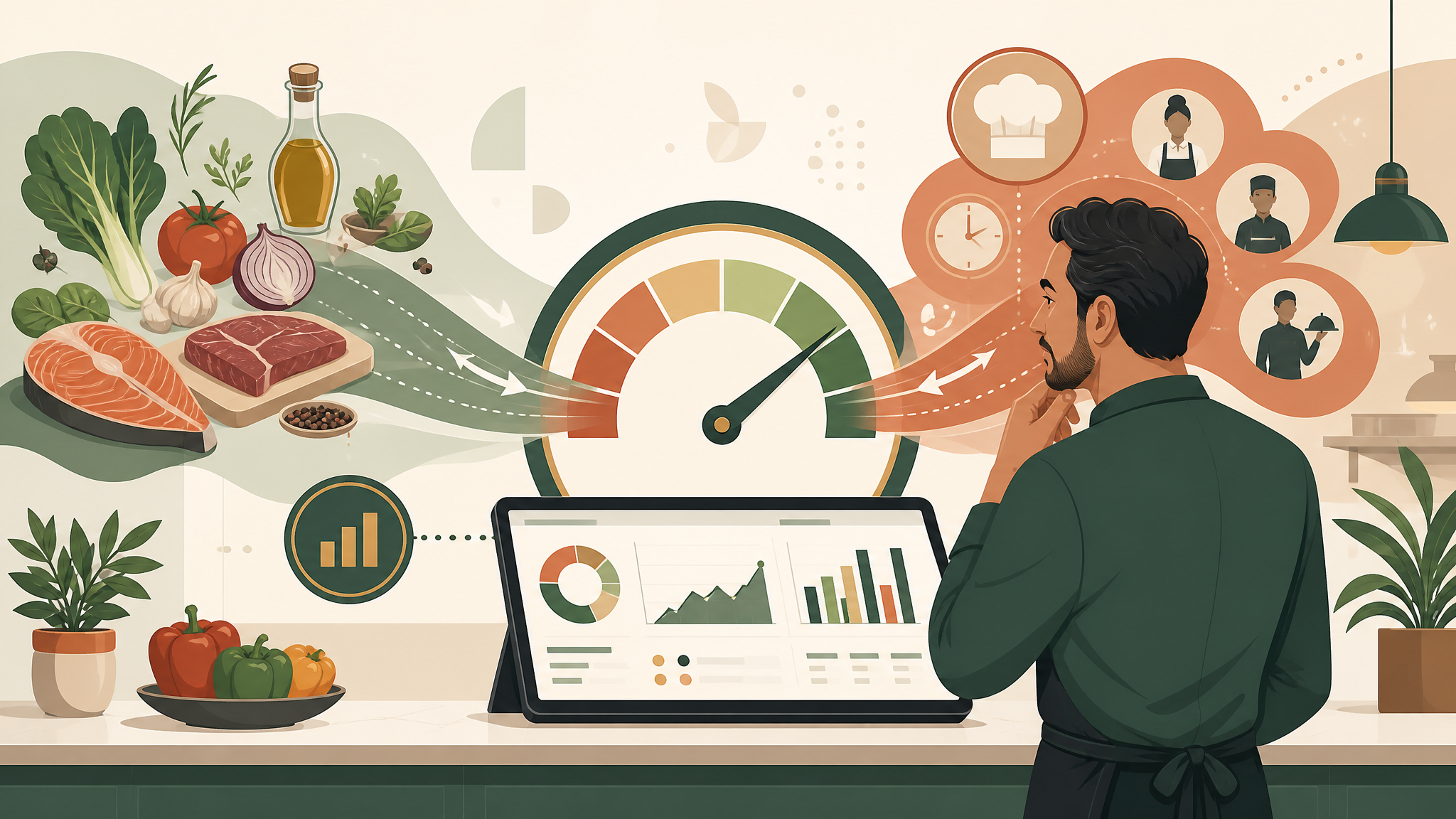
If I could force every restaurant owner in Southeast Asia to track just one number, it would not be revenue. It would not be food cost. It would be prime cost — the sum of your food (and beverage) cost and your total labour cost, expressed as a percentage of sales.
Prime cost is the number that decides whether you keep the lights on. Everything else — rent, utilities, marketing, your own salary — comes out of what is left after prime cost. Get it wrong and no amount of clever marketing saves you. Get it right, week after week, and you have a business.
This guide breaks down exactly what prime cost is, the healthy ranges for 2026, and — most importantly — how to actually track it every week instead of finding out you lost money three months too late.
What Prime Cost Actually Is
Prime cost is simple:
> Prime Cost = Cost of Goods Sold (food + beverage) + Total Labour Cost
Then you divide it by your net sales to get your prime cost percentage:
> Prime Cost % = (COGS + Total Labour) ÷ Net Sales × 100
"Total labour" is the part people get wrong. It is not just your kitchen wages. It includes:
- Hourly and salaried wages (front and back of house)
- Your management salaries
- Employer statutory contributions — CPF in Singapore, EPF/SOCSO in Malaysia, Social Security in Thailand, BPJS in Indonesia
- Overtime, bonuses, and staff meals
The reason prime cost matters more than food cost or labour cost alone is that the two trade off against each other. Buy pre-cut, pre-portioned vegetables and your food cost goes up — but your labour cost goes down because your team preps less. Look at either number in isolation and you will make the wrong call. Look at them together and you see the truth.
The Healthy Prime Cost Ranges for 2026
Here is the industry benchmark every operator should have memorised. A healthy prime cost sits between 55% and 65% of sales. Cross 70% and profitability becomes almost impossible regardless of how tightly you run everything else.
| Concept | Healthy Prime Cost | Food Cost | Labour Cost |
|---|---|---|---|
| Quick-service / kiosk | 55%–60% | 25%–32% | 25%–30% |
| Fast casual | 55%–63% | 28%–35% | 25%–30% |
| Full-service / casual dining | 60%–65% | 30%–35% | 28%–35% |
| Cafe / kopitiam | 55%–63% | 22%–30% | 28%–35% |
| Fine dining | 60%–72% | 35%–44% | 30%–35% |
| Cloud / delivery kitchen | 60%–70% | 28%–35% | 22%–30% |
The target for most independent casual restaurants in the region is to hold prime cost at or below 60%. Every point above that is a point stolen from the money you need for rent and profit.
Free: Restaurant Finance Cheat Sheet
Master your numbers with our cheat sheet covering food cost formulas, break-even analysis, and cash flow templates.
No spam, ever. Unsubscribe anytime.
Why One Point of Prime Cost Equals One Point of Profit
This is the mental model that changes how owners behave. Every one percentage point of prime cost you save drops almost directly to your bottom line.
Take a restaurant doing S$80,000 a month in sales. One percentage point of prime cost is S$800 a month — nearly S$10,000 a year. If your net margin is a typical 8%, you would need roughly S$120,000 in extra sales to generate that same S$9,600 in profit. Cutting one point of prime cost is dramatically easier than finding an extra six figures of revenue.
That is why the operators who win are obsessed with prime cost. It is the highest-leverage number in the building.
The Fatal Mistake: Tracking Monthly Instead of Weekly
Most restaurant owners look at their costs once a month — when the accountant sends the report, usually two weeks after the month has already closed. By then, six weeks of damage is already done. You cannot fix a portioning problem in March that you only discover in mid-April.
The operators who consistently hit their numbers track prime cost weekly. A weekly cadence means you catch a supplier price jump, a scheduling overrun, or a portion-control problem within days, not months.
Here is the simple weekly routine:
It takes about 30 minutes once you have a system. It is the most profitable 30 minutes of your week.
The SEA-Specific Pressures on Prime Cost in 2026
Southeast Asia adds its own pressures to both sides of the prime cost equation:
Labour is getting more expensive and harder to find. Singapore's Progressive Wage Model keeps pushing wage floors up, and a shrinking local workforce means you compete hard for every hire. Malaysia's minimum wage rises and mandatory EPF/SOCSO contributions add real cost on top of the headline wage. Across the region, the days of cheap, plentiful labour are over — which means labour discipline is now non-negotiable.
Food costs are volatile. Imported ingredients swing with the ringgit, baht and rupiah. A weaker local currency quietly inflates your food cost even when your suppliers have not "raised prices."
Both pressures push in the same direction: the operators who track and defend prime cost weekly are the ones still standing in 2027.
How to Actually Lower Your Prime Cost
Attack both halves systematically:
Food cost levers:
- Re-cost your recipes every 90 days against real supplier invoices, not last year's assumptions.
- Track the gap between theoretical food cost (what you should have spent based on sales) and actual (what you did spend). That gap is waste, theft, or over-portioning.
- Standardise portions with scales and portion tools — the cheapest margin fix there is.
- Consolidate suppliers to earn volume pricing, and review the top 10 ingredients by spend monthly.
- Schedule against forecasted covers, not habit. Most labour overruns are rostering problems, not wage problems.
- Build a sales-per-labour-hour target and roster to it.
- Cross-train staff so a slow section can flex to a busy one instead of over-staffing both.
- Use the food-vs-labour trade-off deliberately: sometimes buying prepped items lowers your total prime cost even though food cost rises.
The Bottom Line
Prime cost is not an accounting exercise — it is the operating system of a profitable restaurant. Know your target (60% or below for most concepts), measure it every week, and act on the variance within days. Do that consistently and you will be in the minority of Southeast Asian restaurants that actually make money in 2026.
The owners who fail almost always share the same story: they were "busy," sales looked fine, and they never looked at prime cost until it was too late. Do not be that story. Count your inventory this Sunday.
Tags
Recommended Tools
Put This Knowledge Into Action
Use these tools to apply what you just learned