Kopitiam & Coffee Shop Economics: Can You Really Make Money in 2026?
Coffee has a 70%+ gross margin — so why do so many cafes and kopitiams fail? Because gross margin is not net profit. Here is the real unit economics of running a coffee shop in Singapore and Malaysia in 2026.
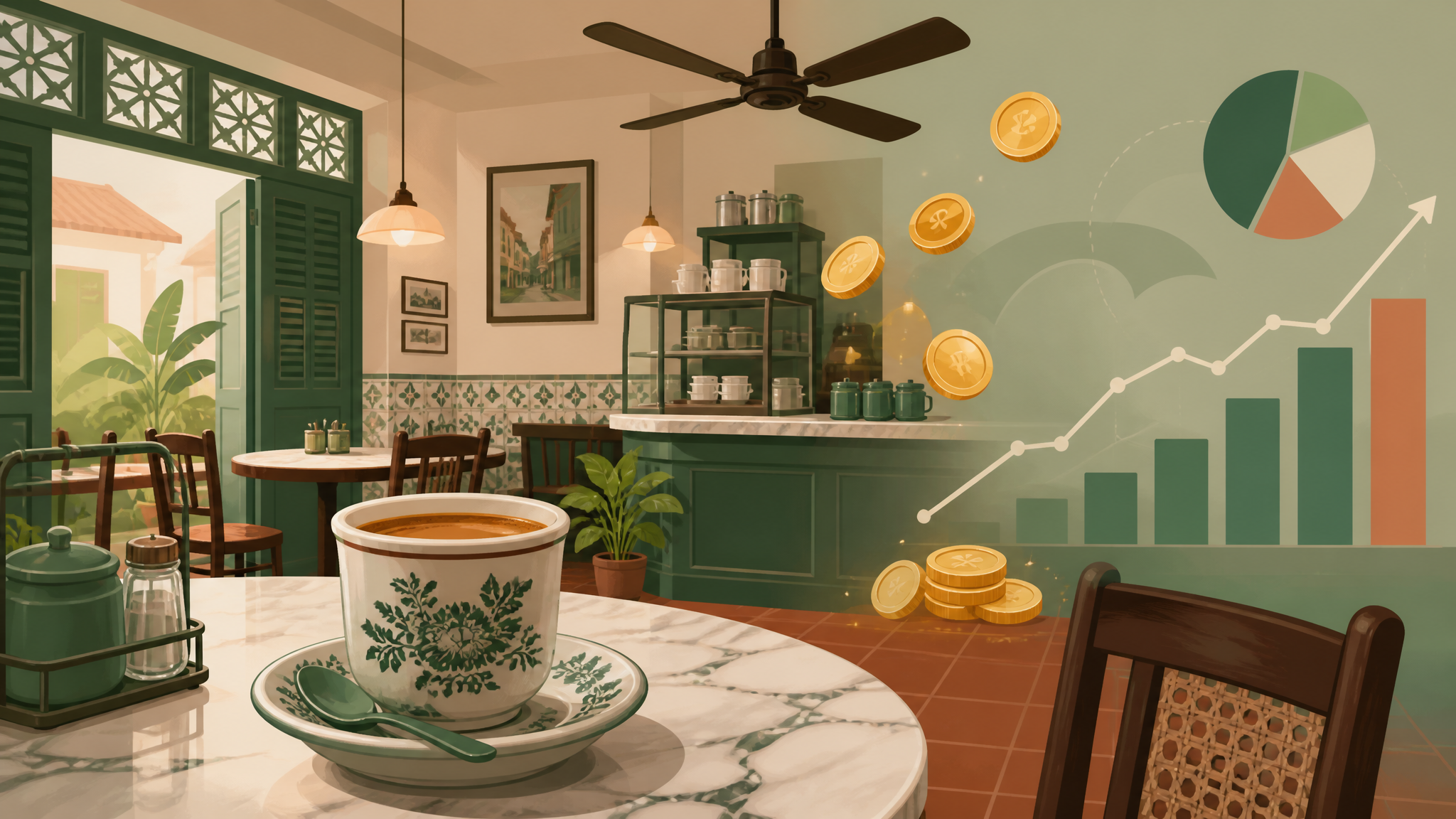
"Coffee costs 60 cents to make and sells for five dollars — it must be a goldmine." I hear some version of this from nearly every first-time cafe owner. Then, twelve months in, they cannot understand why the bank account is empty despite a full shop.
The answer is the single most important lesson in coffee-shop economics: gross margin is not net profit. Let me show you where all that lovely coffee money actually goes in 2026.
The Seductive Gross Margin
It is true that a cup of coffee has a spectacular gross margin. Beans, milk and a cup might cost you 60–90 cents on a drink you sell for S$5–S$7. That is a gross margin north of 60–70%. On paper, it looks unbeatable.
This is exactly the number that lures people into the business — and exactly the number that misleads them. Because a cafe does not sell one cup. It carries rent, staff, equipment, and a hundred other costs that the gross margin ignores entirely.
Where the Money Actually Goes
The brutal reality of cafe economics is that two costs — rent and labour — can consume up to two-thirds of your revenue before you have accounted for anything else.
Rent is the silent killer. In Singapore, a healthy occupancy cost is ideally 10% of revenue or less. Many cafes operate at mid-teens to mid-20s percent. When rent hits 20%+, you are on a treadmill — running hard just to break even, with every quiet afternoon eating directly into survival.
Labour is heavy and rising. Coffee is a service business. You need baristas during every opening hour, whether the shop is full or empty. Singapore's Progressive Wage Model keeps pushing wages up; Malaysia's minimum wage and mandatory EPF/SOCSO contributions add real cost. Labour routinely runs 28–35% of revenue.
Add the two together and a huge slice of every dollar is gone before beans, milk, utilities, delivery commissions (15–30% on delivery orders) and equipment even enter the picture.
Free: Restaurant Finance Cheat Sheet
Master your numbers with our cheat sheet covering food cost formulas, break-even analysis, and cash flow templates.
No spam, ever. Unsubscribe anytime.
The Real Net Margins in 2026
So what actually falls to the bottom line? Here are realistic 2026 figures:
| Operator type | Realistic net margin |
|---|---|
| Established, scaled chains (e.g. Oriental Kopi) | 11%–15% |
| Well-run independent cafe | 10%–15% at best |
| Typical independent | 0%–10% |
| Struggling independent | negative — many never turn a profit |
The pattern is clear: the scaled, disciplined players earn double-digit margins. Many independents earn little or nothing. The difference is almost never the quality of the coffee — it is the discipline of the economics.
In Malaysia, a heritage kopitiam franchise typically needs RM 200,000–400,000 to open. A working owner-operator in an average location might net RM 4,000–8,000 a month; a strong outlet can reach RM 8,000–15,000. Good money for a hands-on owner — but a far cry from the "goldmine" fantasy, and entirely dependent on volume and location.
Why Volume and Location Decide Everything
Because rent and labour are largely fixed, coffee-shop profitability is a volume game. Your costs barely move whether you serve 100 cups or 400 cups a day — but your revenue quadruples. That means:
- Location is destiny. High-footfall spots command high rent, but they deliver the volume that makes the model work. A cheap unit with no traffic is the most expensive mistake you can make.
- Speed and throughput matter. How many transactions can you push through peak hours? That is your profit ceiling.
- The dead hours will kill you. Every hour of paid staff serving an empty room is pure loss. Managing your roster against actual footfall patterns is survival, not optimisation.
The Bifurcated Market: Hawker-Kopi vs Cafe
In Singapore especially, the market splits in two. On one side, the traditional hawker-kopi — state-anchored stalls selling kopi at low prices, competing purely on cost and speed. On the other, experience-led cafes selling a S$7 flat white and an atmosphere.
The danger zone is being caught in between: charging cafe prices without the cafe experience, while competing against kopitiams that will always beat you on price. Pick your side clearly. If you are a cafe, the coffee is table stakes — you are actually selling ambience, consistency and a reason to linger (and spend).
How the Winners Make It Work
The operators earning healthy margins in 2026 almost all do the same thing: they diversify beyond coffee-by-the-cup.
- Food attach. Higher-margin food and all-day dining lift the average transaction well above a single drink.
- Retail and FMCG. Selling roasted beans, packaged products and merchandise adds margin with little extra labour.
- Wholesale and roasting. Supplying beans to other businesses smooths revenue beyond the four walls.
- Tight cost discipline. Weekly prime-cost tracking, rosters matched to footfall, and occupancy held in check.
The successful cafe is rarely just a cafe. It is a small, diversified F&B business that happens to have great coffee at the front.
The Bottom Line
Can you make money running a coffee shop or kopitiam in 2026? Yes — but not because coffee has a great gross margin. You make money by winning the volume game: securing a location that delivers footfall, holding rent under control, matching labour to demand, and diversifying revenue beyond the cup.
Before you sign that lease, model it honestly. Take your realistic daily cup count, apply real rent and real labour, and see what is left. If the numbers only work at 400 cups a day and your location does 150, no amount of latte art will save you. The romance of a cafe is real — but the economics decide whether you get to keep living it.
Tags
Recommended Tools
Put This Knowledge Into Action
Use these tools to apply what you just learned