Central Kitchen or Not? The Multi-Outlet Scaling Decision for SEA Restaurants (2026 Unit Economics)
A central kitchen can unlock multi-outlet growth — or sink you under fixed costs before you are ready. Here is the unit-economics framework for deciding when to build a commissary, and why the jump from 3 to 6 outlets is the real test.
Every successful single-outlet operator eventually faces the same question: how do I grow without the whole thing falling apart? And somewhere around the third or fourth store, a second question appears — do I need a central kitchen?
Get the timing right and a commissary unlocks clean, profitable expansion. Get it wrong — build too early — and you saddle a small business with a fixed cost it cannot fill. Here is how to think about it in unit-economics terms.
What a Central Kitchen Actually Does
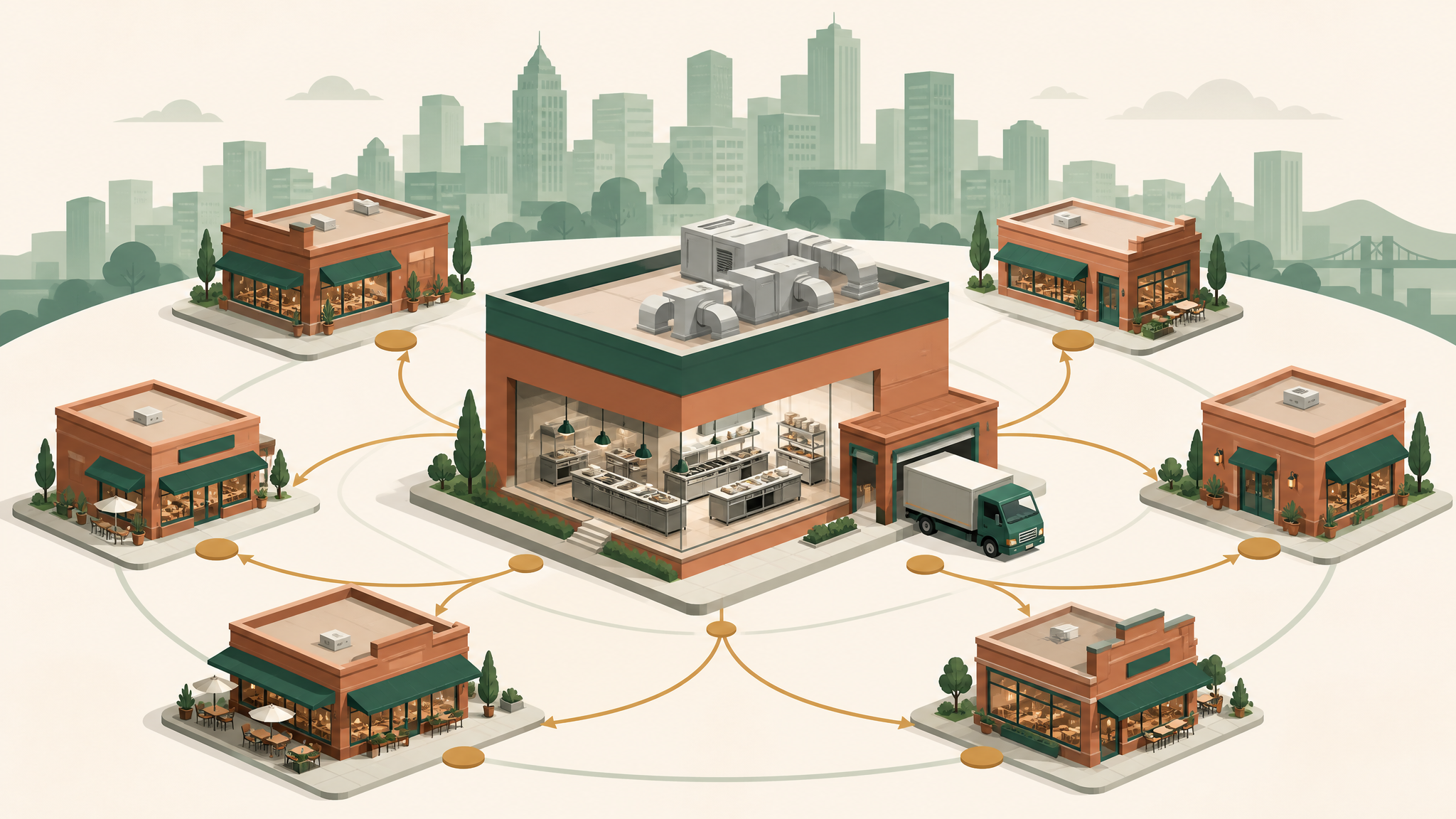
A central kitchen (or commissary) is a dedicated production facility that preps and produces food for multiple outlets. It is the hub in a hub-and-spoke model: the commissary does the heavy production, and each outlet finishes and serves.
The benefits are real:
- Purchasing power. Buying for six outlets at once earns volume pricing that a single store never gets.
- Consistency. The same sauce, the same portion, the same quality across every location — because it all comes from one place.
- Lower outlet labour. Each store needs less skilled prep labour, so you can open smaller, cheaper outlet footprints.
- Food safety control. Centralised HACCP compliance, batch tracking and expiry management are far easier in one facility than across six independent kitchens.
The Trap: Fixed Cost Before You Have the Volume
Here is what kills operators who scale too fast. A central kitchen is a large fixed cost — rent, specialised equipment, skilled production staff, and delivery logistics. That cost exists whether it is producing for three outlets or ten.
Spread across ten busy outlets, the commissary cost per outlet is small and the savings are huge. Spread across three, it is dead weight that drags down your whole group. Building a commissary is essentially betting that your outlet count will grow fast enough to fill it — soon.
That is why the honest answer to "should I build a central kitchen?" is almost always: not yet, and here is the number that tells you when.
Free: Daily Operations Playbook
Download our proven daily operations playbook used by successful restaurant owners to run smooth, profitable shifts.
No spam, ever. Unsubscribe anytime.
The Rough Threshold: Around 5 Outlets
Industry experience consistently points to the same range. Manual systems — spreadsheets, group chats, each chef doing their own prep — start breaking down at 3 to 5 outlets. That is when you feel the pain: recipes drift, quality varies store to store, purchasing is chaotic, and you personally cannot be everywhere.
Most operators find the central kitchen math works once they are at or heading quickly toward 5+ outlets. Below that, you are usually better off with a lead "mother" outlet that preps for one or two satellites — a lightweight commissary without the standalone facility cost.
The real trigger is not a fixed store count — it is whether the savings across your outlets exceed the fixed cost of the facility. Run that calculation before you sign a lease:
> Will (per-outlet labour + purchasing savings) × (number of outlets) exceed the monthly fixed cost of the central kitchen? If yes, build. If no, wait.
Why the Jump From 3 to 6 Outlets Is the Real Test
Three outlets can be run on founder attention. You can personally visit each one, taste the food, fix problems, and secure the three best locations in your city. Performance at three stores is largely a function of site quality and your own energy.
Six outlets is a different business entirely. You cannot be everywhere. Performance stops being about "did we get the best sites" and becomes about system depth:
- Are your recipes and SOPs documented well enough to run without you in the room?
- Is your labour model robust in a shrinking, expensive SEA workforce?
- Does demand hold at the fourth, fifth and sixth locations — which are rarely as perfect as your first three?
This is the moment a central kitchen earns its keep — not because it saves a few dollars, but because it is the system. It forces standardised recipes, centralised costing, and consistent quality that no longer depends on any single chef. The commissary is how you convert founder-dependent success into a repeatable machine.
The Numbers to Model Before You Build
Do not build on ambition. Build on a model:
Most operators who implement efficient central-kitchen systems see the return within a few months once utilisation is there. The whole risk is in that phrase — once utilisation is there.
The Single Point of Failure Risk
One more thing the brochures skip: centralising production creates a single point of failure. If the commissary goes down — equipment failure, a failed inspection, a supply disruption — every outlet is affected at once. Build in redundancy, keep a manual fallback for critical items, and never let one facility become an un-hedged bet on your entire group.
The Bottom Line
A central kitchen is not a status symbol — it is a fixed cost that only pays off at scale. Stay lightweight (a mother-outlet model) until you are at or clearly racing toward five-plus outlets, then build when the per-outlet savings genuinely exceed the facility cost.
And remember what the 3-to-6 jump is really testing: not whether you can open outlets, but whether your system holds when the next locations are no longer the perfect ones. The operators who document their systems before they scale are the ones who make it to ten. The ones who wing it rarely make it past five.
Tags
Recommended Tools
Put This Knowledge Into Action
Use these tools to apply what you just learned