Vietnam’s E-Invoice and Tax Crackdown: What Restaurants and Cafes Must Do in 2026
Decree 70 forces Vietnamese restaurants and cafes to issue e-invoices straight from connected cash registers, while the 8% VAT relief runs only through end-2026 and coffee chains squeeze independents. Here is the compliance-and-survival guide Vietnamese F&B operators need.
What Does Decree 70 Require From Restaurants and Cafes?
Decree 70/2025/ND-CP (effective 1 June 2025) amended Vietnam’s invoicing framework and put consumer-facing F&B squarely in scope. The core requirements:
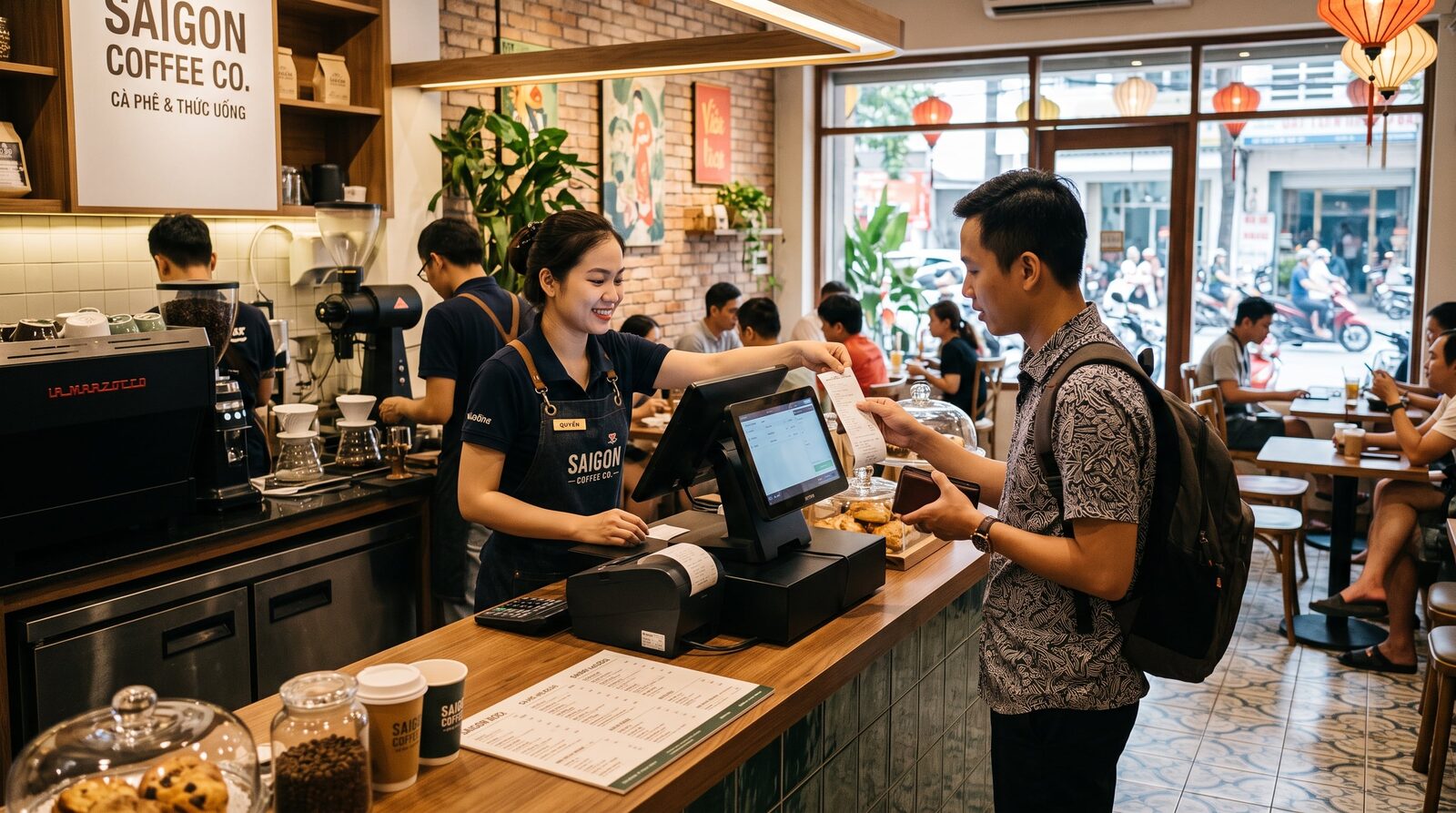
- Cash-register e-invoices. Businesses in retail, hospitality, restaurants, food service, and personal services must issue e-invoices generated by POS/cash-register systems.
- Real-time connection to the tax authority. Your cash register must transmit invoice data to the General Department of Taxation’s system.
- Revenue threshold. The requirement applies to business households and companies with annual revenue of at least VND 1 billion.
- No digital signature required on cash-register e-invoices — but the invoice must still carry seller identity, date, item descriptions, and pricing/tax details, and be verifiable through the tax portal.
The practical effect: your daily sales are visible to the tax authority in near real time. Under-reporting revenue — long common in cash-heavy F&B — is no longer viable.
Who Is Affected, and What About Small Cafes?
| Business Type | Annual Revenue | E-Invoice From Cash Register? |
|---|---|---|
| Restaurant / cafe (company) | VND 1 billion+ | Required |
| Business household | VND 1 billion+ | Required |
| Very small stall / cafe | Below VND 1 billion | Generally outside the mandate |
A modest cafe doing VND 90–100 million a month already crosses the VND 1 billion annual line — so the mandate reaches far more of the market than owners assume. If you are anywhere near that revenue, plan to comply.
Free: Restaurant Compliance Checklist
Stay compliant with our comprehensive checklist covering food safety, health regulations, and licensing requirements.
No spam, ever. Unsubscribe anytime.
What Is Happening With VAT in 2026?
Vietnam extended its VAT reduction from 10% to 8% through 31 December 2026 to support consumption. For F&B, this is a modest tailwind — lower VAT on most food service supports demand. But note:
- The reduction excludes certain sectors (telecom, finance/banking, securities, insurance, real estate, some mining/metal goods, and special-consumption-tax items).
- It is currently set to expire at the end of 2026, so build your 2027 plans assuming a possible return to 10% unless extended again.
Combine transparent e-invoicing with correctly applied VAT, and your pricing and margins must be modelled precisely — there is nowhere left to hide sloppy accounting.
The Competitive Squeeze: Chains vs Independents
Vietnam’s coffee culture is world-class, but scale is consolidating. Well-capitalised domestic chains expand aggressively with prime locations, loyalty apps, and supply-chain buying power. Independents face:
- Price pressure from chains’ economies of scale.
- Rising rents in prime districts of Ho Chi Minh City and Hanoi.
- Wage growth as skilled baristas and cooks command more.
- Delivery commissions (GrabFood, ShopeeFood, Be) of 20–30% that erode already thin margins.
Transparency plus competition means only well-run independents survive.
What Should Vietnamese F&B Operators Do Now?
Step 1: Get a Compliant POS
Adopt a cash-register/POS system that generates connected e-invoices and transmits to the tax authority. This is now the price of doing business, not optional.
Step 2: Clean Up Your Books
Move fully to accurate revenue recording. With real-time data flowing to the tax office, reconcile daily and keep robust internal records to support every transaction.
Step 3: Re-Model Pricing and Margin
With transparent VAT (8% through 2026) and visible revenue, recalculate menu pricing so you protect margin while staying competitive.
Step 4: Differentiate From the Chains
Compete on specialty quality, unique concept, community, and service — not on price against chains that will always undercut you.
Step 5: Reduce Delivery Dependency
Build direct ordering and loyalty (Zalo, your own channels) to claw back the 20–30% commissions delivery platforms take.
👉 [Model your true costs and breakeven under 2026 rules with our free City Cost Calculator](/tools/startup-cost-by-city) — with current data for Ho Chi Minh City, Hanoi, and Da Nang.
Frequently Asked Questions
Do restaurants and cafes in Vietnam need e-invoices in 2026?
Yes — under Decree 70/2025 (effective 1 June 2025), restaurants, cafes and food-service businesses with annual revenue of at least VND 1 billion must issue e-invoices generated by cash registers connected in real time to the tax authority.
What is the VAT rate for restaurants in Vietnam in 2026?
The VAT reduction from 10% to 8% has been extended through 31 December 2026 for most goods and services, including most food service. It is set to expire at the end of 2026 unless extended again.
Do cash-register e-invoices need a digital signature in Vietnam?
No. Cash-register e-invoices under Decree 70 do not require a digital signature, but must contain seller identity, date, item details, and pricing/tax information, and be verifiable via the tax portal.
How can independent cafes compete with big Vietnamese coffee chains?
Differentiate on specialty quality, distinctive concept, community and service; build direct/loyalty ordering to cut delivery commissions; and keep prime cost tightly controlled.
The Bottom Line
2026 is the year Vietnamese F&B becomes fully transparent to the tax authority. Decree 70 e-invoicing, time-limited 8% VAT, and intensifying chain competition mean success now depends on clean books, precise pricing, genuine differentiation, and less reliance on delivery platforms. Operators who professionalise will thrive; those who cling to cash-era habits will not.
👉 [Not sure your cafe or restaurant is ready for 2026? Take our free Restaurant Readiness Quiz](/quiz) — it checks your financial and operational readiness in under 5 minutes.
Tags
Recommended Tools
Put This Knowledge Into Action
Use these tools to apply what you just learned