One Bad Yelp Review Can Cost You $8,000 — Here's How to Master Online Reputation
Online reviews now drive 90% of dining decisions. Learn the proven system for generating positive reviews, responding to negative ones, and turning your reputation into a revenue engine.
A study by Harvard Business School found that a one-star increase in Yelp rating leads to a 5-9% increase in revenue. For a restaurant doing $1 million a year, that's $50,000-90,000.
Flip that around: a one-star decrease could cost you the same amount.
I've watched this play out in real time. A client of mine in San Francisco had a 4.3-star Google rating and was doing well. Then three negative reviews hit in one week — a bad night when the kitchen was short-staffed. His rating dropped to 3.9 stars. Within two months, his weekend reservations dropped 25%.
The food hadn't changed. The experience, on most nights, was still excellent. But the internet had decided otherwise, and potential customers were choosing his competitors based on a number next to his name.
This is the reality of the restaurant business in 2026. Let me show you how to take control of it.
The Numbers That Should Get Your Attention
| Statistic | Source |
|---|---|
| 90% of diners research restaurants online before visiting | BrightLocal |
| 94% say a negative review has convinced them to avoid a business | ReviewTrackers |
| 53% of customers expect a response to negative reviews within 7 days | ReviewTrackers |
| Restaurants with 4.0-4.5 stars generate the most revenue | Harvard Business School |
| A single negative review costs approximately $8,000 in lost revenue | Moz |
Your online reputation isn't a vanity metric. It's a direct revenue driver.
Part 1: Building a Review Generation System
Why You Can't Just Hope for Reviews
Here's the psychological problem: unhappy customers are 2-3x more likely to leave a review than happy ones. Without a system, your review profile naturally skews negative.
You need to actively, systematically encourage your happy customers to share their experience.
The 3-Touch Review System
Touch 1: The In-Restaurant Ask (Most Effective)
Train your servers to identify satisfied guests (clean plates, compliments, positive body language) and say:
"I'm so glad you enjoyed your evening! If you have a moment, a Google review would really mean the world to us. It's how new customers find us."
Hand them a small card with a QR code linking directly to your Google review page. Not Yelp, not TripAdvisor — Google first, because Google reviews have the highest impact on search visibility.
Touch 2: The Follow-Up (For Direct/Reservation Customers)
If you collect emails through reservations or your loyalty program, send a brief email 24 hours after their visit:
"Hi [Name], thank you for dining with us last night! We'd love to hear your feedback — it helps us keep improving. [Leave a Review button]"
Keep it simple. One sentence, one button, no clutter.
Touch 3: The Receipt Prompt
Add a small note to the bottom of receipts:
"Loved your meal? Tell the world! [Google Review QR Code]" "Something wasn't right? Tell us directly: [email protected]"That second line is critical — it gives unhappy customers a private channel before they go public.
Free: Restaurant Marketing Toolkit
Get our marketing toolkit with social media templates, promotion calendars, and local SEO tips that actually work.
No spam, ever. Unsubscribe anytime.
Part 2: Responding to Reviews (The Right Way)
The Golden Rules
For Positive Reviews:
Good example:
"Thanks so much, Sarah! Our chef will be thrilled to hear the braised short rib was the highlight — it's his grandmother's recipe. We hope to see you again soon!"Bad example:
"Thank you for your feedback! We appreciate your patronage and look forward to serving you again."(The bad example could be auto-generated. Customers can tell.)
For Negative Reviews: The LEARN Framework
I teach all my clients the LEARN method:
| Step | Action | Example |
|---|---|---|
| Listen | Acknowledge their experience without defensiveness | "Thank you for sharing your experience, and I'm sorry it fell short." |
| Empathize | Show you understand their frustration | "I completely understand how disappointing a long wait can be, especially on a special occasion." |
| Apologize | Take responsibility without excuses | "That's not the standard we hold ourselves to, and I take full responsibility." |
| Resolve | Offer a specific solution | "I'd love the opportunity to make it right — please email me directly at [email]." |
| Next | State what you're doing to prevent recurrence | "We've already adjusted our reservation spacing to prevent this in the future." |
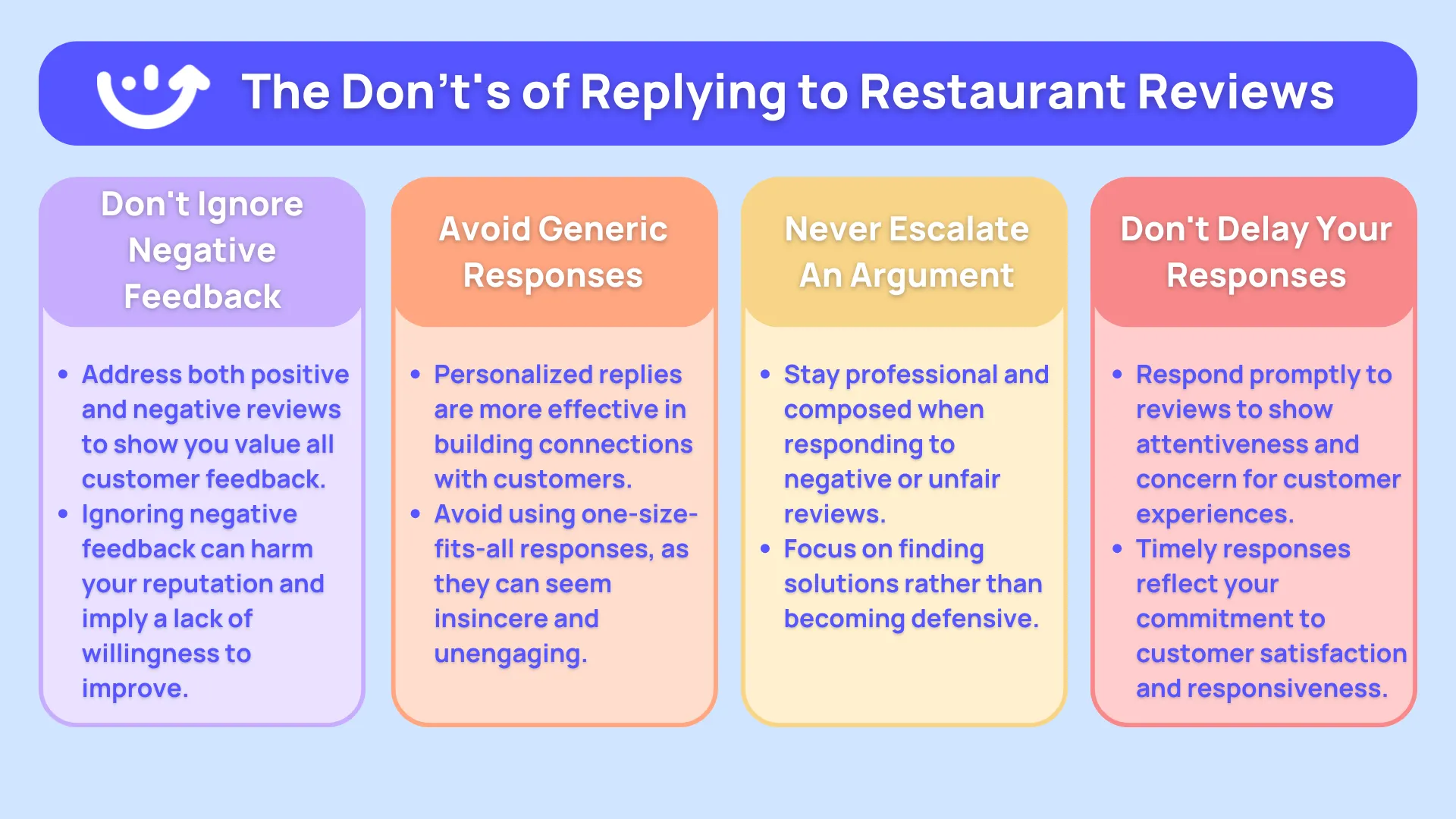
What NEVER to Do
- Never argue with a reviewer publicly — you lose even when you're right
- Never accuse them of lying — even if they are
- Never offer compensation in a public reply — it encourages fake negative reviews
- Never ignore negative reviews — silence looks like indifference
- Never copy-paste the same response to multiple reviews — it looks lazy and robotic
Part 3: Handling the Truly Unfair Review
Sometimes reviews are genuinely unfair — wrong restaurant, factually false, or from a competitor. Here's what you can do:
For Google Reviews:
For Yelp Reviews:
Part 4: Turning Reviews Into Operational Gold
Here's something most owners miss: reviews are free consulting. Your customers are telling you exactly what you're doing right and wrong.
The Monthly Review Audit
Every month, read every review from the past 30 days and categorize feedback into:
| Category | Track |
|---|---|
| Food quality & taste | Specific dishes praised or criticized |
| Service speed | Wait times, attentiveness |
| Staff friendliness | Specific staff mentions |
| Ambiance | Noise, cleanliness, temperature |
| Value perception | "Worth it" or "overpriced" sentiment |
When you see the same complaint three times, it's not a coincidence — it's an operational problem that needs fixing.
A barbecue restaurant I work with noticed four reviews in one month mentioning "dry brisket." Turned out their pit master had changed the smoking time. They caught it through review monitoring, fixed it, and their ratings recovered within six weeks.
Part 5: Advanced Reputation Strategies
The "Review Velocity" Advantage
Google's algorithm favors businesses with consistent, recent reviews over those with more total reviews. Ten reviews in the last 30 days outrank 500 reviews from two years ago.
This means your review generation system needs to be ongoing, not a one-time campaign.
Leveraging Reviews in Marketing
- Feature 5-star quotes on your website, menu, and social media
- Create "wall of love" displays in your restaurant
- Use specific review quotes in ads: "Best tacos north of the border — Sarah M., Google Review"
- Share positive reviews in Instagram stories (screenshot + thank you)
The Bottom Line
Your online reputation is not something that happens to you. It's something you build, manage, and protect — every single day.
The system is simple:
Do this consistently for 6 months and watch what happens to your rating, your reservations, and your revenue.
Want to build your marketing plan? Our [AI F&B Consultant](/chatbot) can help you develop a comprehensive reputation management strategy tailored to your restaurant.
Tags
Recommended Tools
Put This Knowledge Into Action
Use these tools to apply what you just learned